You know you want to go somewhere.You just don’t know where.
Tell Trippé who’s going, the mood you’re chasing, roughly when, and what feels comfortable to spend. You get one place back — with what it really costs.

FreeNo adsNothing to unlock
No endless tabs. No comparison spreadsheets. Just somewhere to go.
Five questions. One answer.
About two minutes — answer like you’d text a friend.
- 1
Who’s going?
Just you, a plus-one, or the whole group chat.
- 2
When, roughly?
A month is specific enough. Trippé finds the best window in it.
- 3
What’s the vibe?
Warm and slow? A city that stays up late? Nature, no plans at all?
- 4
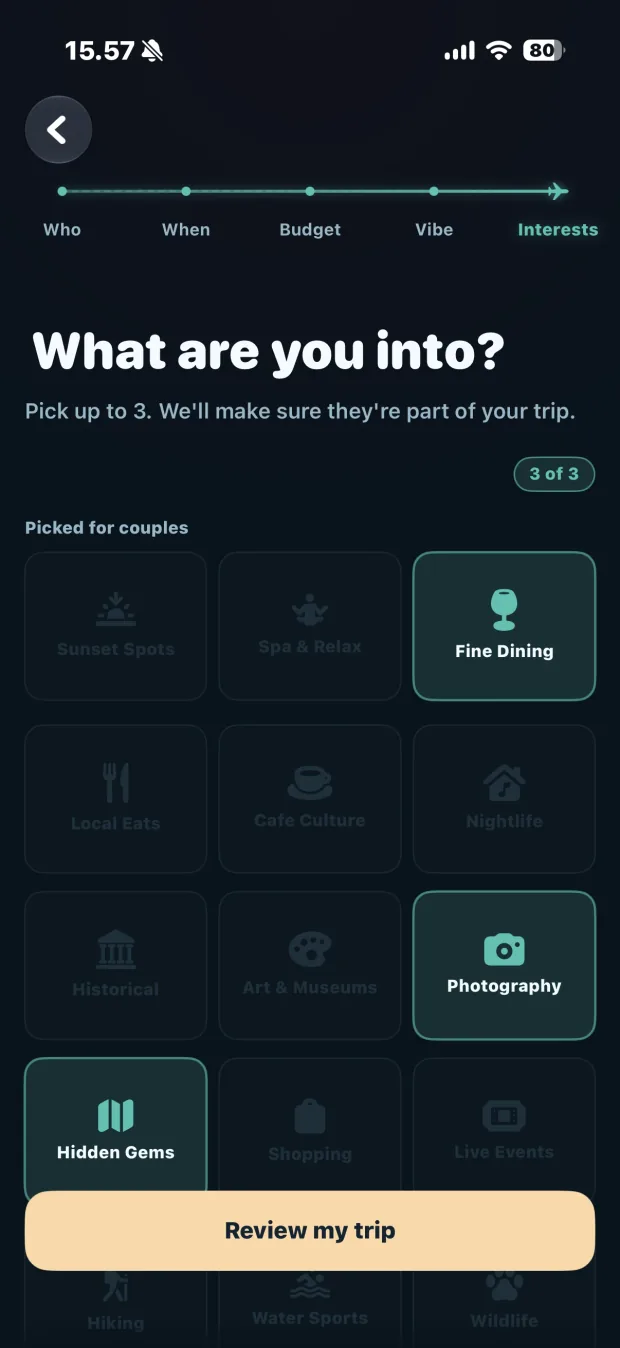
Pick up to three
The things you’re actually into — they end up inside the itinerary.
- 5
Comfortable spend?
Not your maximum — the number that would feel right.
Then Trippé goes and does the digging — and you get one place back.
What you ask
Your whole trip, in one line
Tap any underlined word and the example rewrites itself. In the app, this sentence is the entire intake — no forms, no dropdowns.
I want to discover departing from with , for on with a mix of vibes.
An example answerSão Miguel (Azores, Portugal)
“Lush volcanic ridges plunging into sapphire crater lakes, warm thermal springs, and quiet cobblestone towns.”
TAP Portugal · 1 layover · $410 per person$820 – $940Illustrative example — the receipts further down are real, dated sessions.
What you get back
One place. The whole picture.
A destination chosen for your reasons, what it would really run for your group, and the month to go — every number labelled for what it is.
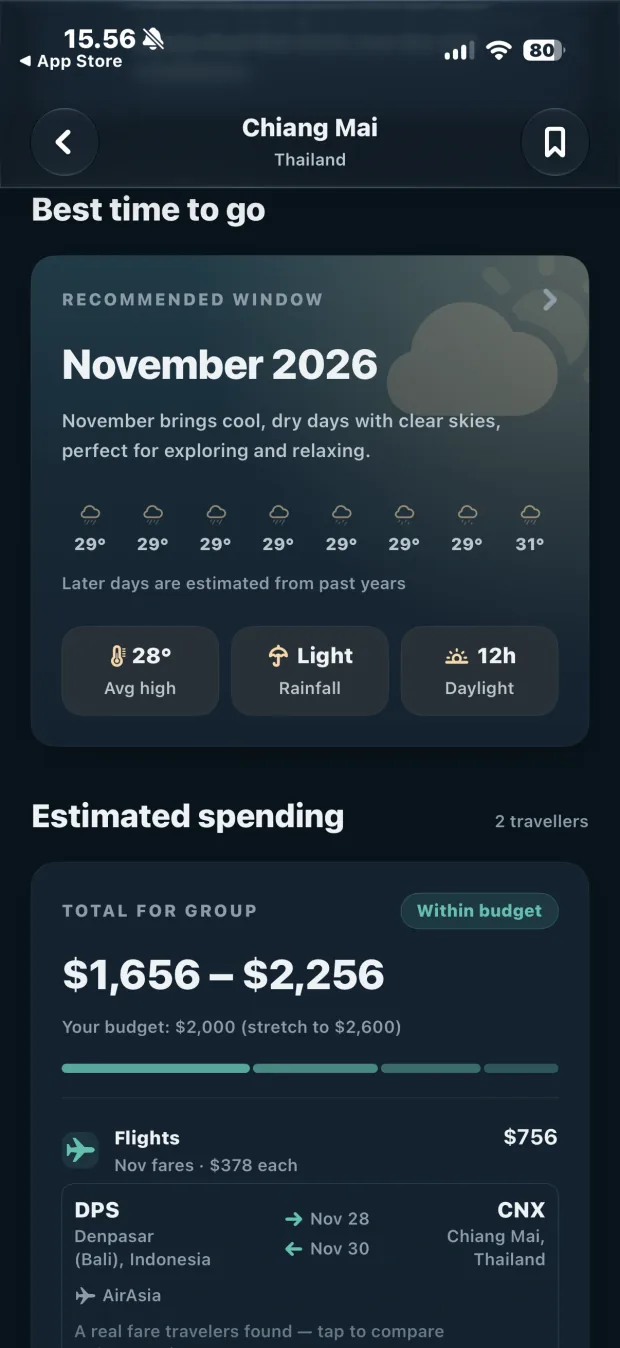
$1,656 – $2,256
Your budget: $2,000 (stretch to $2,600)
- FlightsNov fares · $378 each
- $756
- Stays14 nights · Budget hotel
- $400 – $600
- Food & local transit14 days · 2 people
- $300 – $500
- ActivitiesTrip total
- $200 – $400
≈ $1,000 per person
AirAsia · a real fare travellers found — an observation, not part of the total
Trying our best for live prices — these numbers are our best estimate for now
One real session · captured August 2026 · unedited
Where the numbers come from
Numbers are easy to fake. These aren’t.
Every figure survives questioning — the month has its reasons attached, the fare has a date on it, and nothing pretends to be more certain than it is.
The month comes with its reason
Years of past weather and daylight are compared before November gets suggested — and anything further out says so.
Fares are observations
When a price is one travellers actually found, it says so — airline and route included. Everything else stays a labelled estimate.
Ranges, never fake precision
A stay is “$400 – $600”, not “$487”. Honest spreads you can actually plan around.
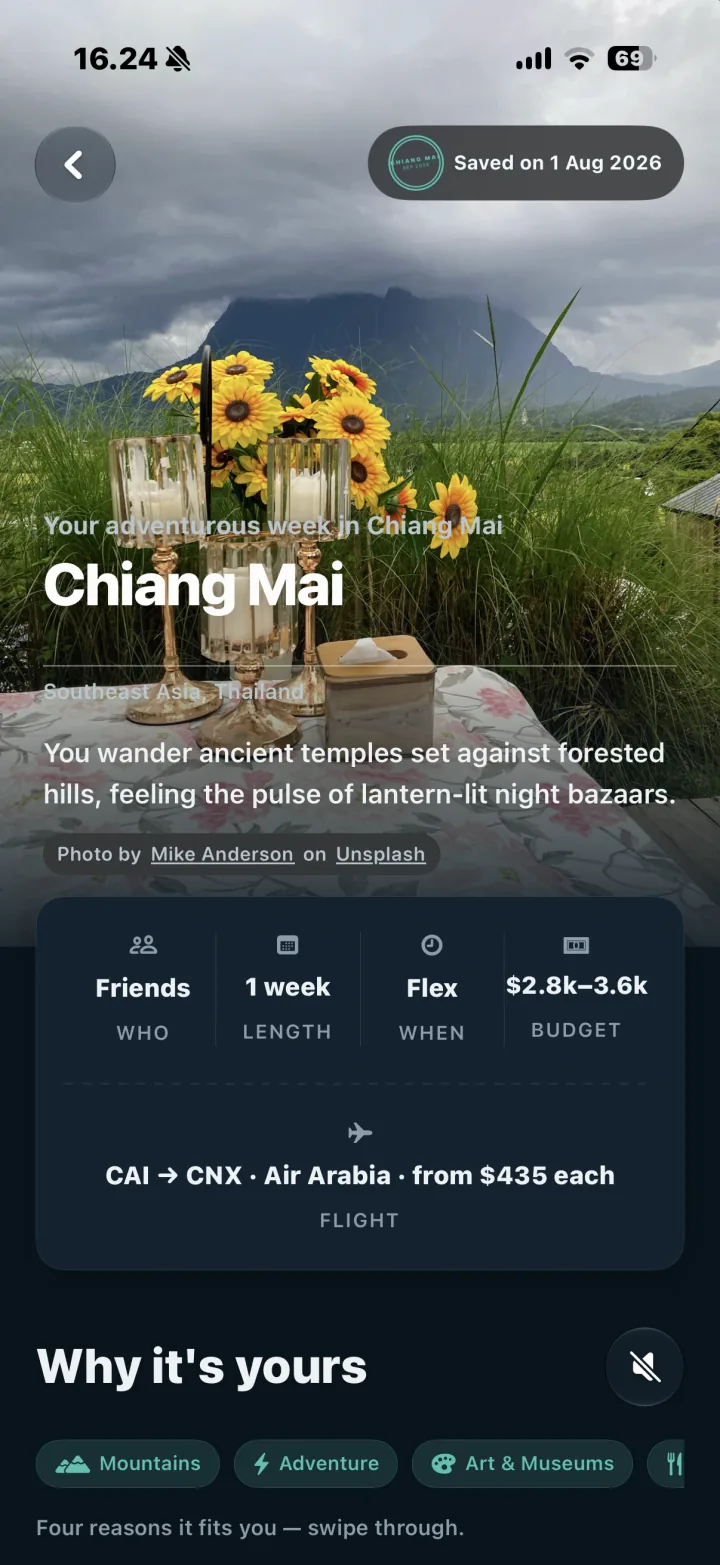
You wander ancient temples set against forested hills, feeling the pulse of lantern-lit night bazaars.
Chiang Mai — chosen for Mountains, Adventure and Art & Museums
One real answer — not a feed of 200 cities. And if it isn’t you, alternatives come back chosen the same way.
Closer to home
Ubud
Mist rolls over the rice terraces, and the sound of water from a thousand…
Newest discovery
Kandy
The lake reflects the Temple of the Tooth at dusk, and the hills around…
Real photographs
Of the place — so it’s a destination, not a name on a screen.
Trips worth keeping
Save them. Sign in with Apple for other devices — entirely optional.
Free, and staying that way
No subscription, no ads, nothing locked away. There’s a tip jar — it unlocks nothing, because there’s nothing to unlock.
We don’t track you across other apps or websites, we don’t use your data for advertising, and we don’t sell it. Read the privacy policy
How much does Trippé cost?
Nothing. No subscription, no ads, nothing locked behind a paywall. There’s an optional tip jar for people who want to support it — it unlocks nothing, because there’s nothing to unlock.
Do I need an account?
No. You can use Trippé without one. Sign in with Apple is there if you want your saved trips on your other devices — that’s the only thing it does, and you can delete your account from inside the app at any time.
Does it book anything for me?
No — Trippé is the step before booking. It works out where to go and what it would roughly cost; the prices are estimates, clearly labelled as estimates, never bookable quotes. Once you know where, you book however you like.
Why only one destination?
Because a list of 200 cities is just the internet wearing a travel hat. One answer, chosen for your stated reasons, is something you can act on — and alternatives come chosen by the same logic if the first pick isn’t you.
How is this different from asking around online?
You could spend an evening collecting opinions, then fact-checking flights, weather and prices yourself. Trippé does the digging and shows its work: observed fares with the airline named, a month picked from years of weather history, and itemised costs marked as estimates.
Are the prices on this page current?
No — and they say so. Everything here comes from real sessions captured in August 2026: fares are dated observations, everything else is a labelled estimate. Fares move constantly; treat these numbers as evidence of what a trip can cost, then check live prices when you actually book.
Where do Trippé’s answers come from?
Years of weather history (Apple Weather and Open-Meteo), fares real travellers found on your route, and destination matching against exactly what you asked for. Every answer ships with its sources attached — airline names, date ranges, historical averages — so you can judge it yourself.
What if the first pick isn’t right?
That’s what alternatives are for. Every result comes with other destinations chosen the same way, for the same reasons. If none of them land, change an answer and go again.
Where does Trippé work from?
Anywhere you’d start from. Ask from Cairo, London or São Paulo — fares are estimated from your nearest airport, and the destinations span the whole map.
Pack your bags.
Two minutes now beats two hundred open tabs tonight.